

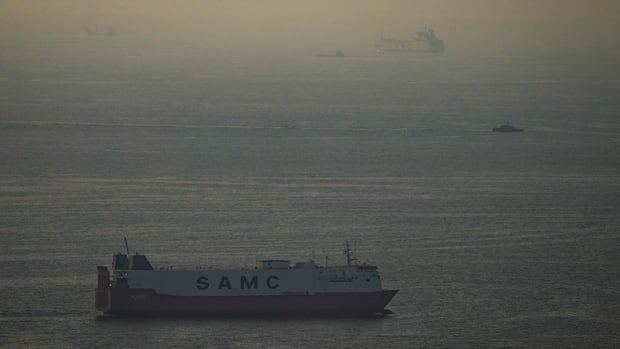




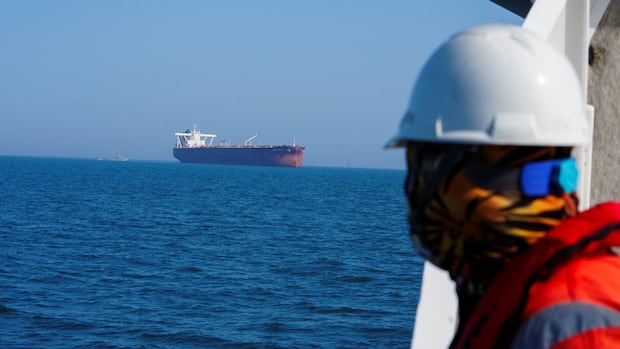

Despite assurances from both Iran and U.S. President Donald Trump that the Strait of Hormuz was again open to traffic, very little appeared to have changed on Friday.
Not for the first time in the past seven weeks of war and tenuous ceasefire, the details of developments concerning the critical waterway — whose effective closure since the U.S. and Israel launched strikes on Iran on Feb. 28 has debilitated global trade and sent oil prices soaring — have been sparse.
Here's what we know and don't know about the movement of shipping through the strait, and the wider effects of all this uncertainty.
Is the strait really open?Restoring marine traffic through the strait currently hinges on two fragile, short-term ceasefires.
A two-week ceasefire between Iran and the U.S. has been in place since April 7, but talks since then on ending the war have foundered.
With Tehran continuing to apply a chokehold on the Strait of Hormuz — because the ceasefire had not included Israel's strikes on Hezbollah targets in Lebanon — the U.S. set up its own blockade of ships coming to and from Iran in the Gulf of Oman, east of the strait, beginning April 13.
Following Thursday's announcement of a 10-day ceasefire in Lebanon, Iranian Foreign Minister Abbas Araghchi said Friday the strait would open for all commercial vessels as long as the cessation of hostilities remains in place.
But the U.S. has not backed down on its naval blockade, and it appears it will only be lifted when Iran agrees to wider terms — with just days until the ceasefire is set to end.
Iran has now warned it will take "necessary reciprocal measures" if the U.S. blockade continues. While it offered no details, this presumably means Tehran will lock down the strait again.
WATCH | The Strait of Hormuz is open, Iran and the U.S. say. But for how long?After more than six weeks of the de facto closure of the world's most critical energy chokepoint, Iran said the Strait of Hormuz was "completely open" to ship traffic. But as Andrew Chang explains, a few key factors complicate how open the shipping route actually is, and how long the status quo might hold. Images provided by The Canadian Press, Reuters and Getty ImagesAccordingly, with all the uncertainty, marine traffic through the Strait of Hormuz remained effectively at a standstill on Friday.
Around 20 vessels began sailing toward the strait in the evening but soon halted, with some turning back, data from Marine Traffic showed. It was not immediately clear why the ships stopped.
As of midnight Saturday in Tehran, Marine Traffic still showed oil tankers and container vessels clustered either side of the strait.
Twenty vessels would still be a far cry from what used to navigate the channel — UN Trade and Development estimated as many as 151 ships were transiting through daily in February.
WATCH | U.S. keeps naval blockade in place for ships heading to and from Iran:U.S. President Donald Trump and Iran's foreign affairs minister say the Strait of Hormuz is open during the ceasefire between their countries, as they negotiate a peace deal. Trump also said the U.S. naval blockade is still in place, but only for Iranian vessels.Is the strait safe?While a handful of ships have been hit by projectiles since the war began, another big source of uncertainty is how heavily the strait has been mined.
Trump said earlier Friday that Iran, with U.S. help, "has removed or is in the process of removing all sea mines it had placed in the strait." Iran gave no corroboration, and it remains unclear how many mines have been laid and how many remain.
U.S. officials quoted by the New York Times said Iran hasn't been able to locate all of the mines it laid and doesn't have the capability to remove them.
Admiral Brad Cooper, the top U.S. commander in the Middle East, confirmed the U.S. military will be working to clear mines from the strait but offered no details on the scope of the task.
WATCH | No trade shock compares to the one created by Iran war, analyst says:The economy has seen trade shocks before, such as the Russian invasion of Ukraine, but 'nothing compares to this scale,' says Alexis Ellender, global trade analyst for Kpler.Clearing a strategic waterway such as the Strait of Hormuz would be a multi‑step process that could take two to three weeks, former naval officers and industry specialists have said.
The lack of any clear information on the quantity of mines and their location is clearly causing nerves among shipping companies. The head of the Norwegian Shipowners' Association, Knut Arild Hareide, said there are "a number of outstanding uncertainties" in the strait's reopening, "including questions related to the presence of sea mines."
How long would it take to restore traffic?While there are safety and security challenges to getting marine traffic flowing again, there is also a stark logistical one.
More than a thousand ocean-going vessels have been trapped in the Persian Gulf for weeks, according to Daejin Lee, global head of research at Fertmax FZCO.
The strait is just 33 kilometres wide at its narrowest point and navigable channels for huge tankers and container ships are much narrower, so it won't be a simple case of letting everyone set sail at the same time when conditions are right.
It would likely take more than two weeks to clear the backlog even under normal conditions, Lee said.
Nils Haupt, senior director of communications of German shipping giant Hapag-Lloyd, said a lot more detail and reassurance is needed before vessels can leave.
"Who is leaving first? Will it be like a chain? How is the procedure? This is all information we would need to know and because priority No. 1 is safety and security of the seafarers," Haupt said.
When could energy prices start to come down?Haupt's concerns point to another major factor in the global consequences of the strait's closure: time.
Markets may have reacted positively Friday to news of the strait's apparent reopening, but with Gulf exports now effectively stalled for seven weeks, supply — and prices — will take a long time to recover.
"Oil only travels at the speed of a tanker," Rory Johnston, founder of Commodity Context, told CBC News in late March. Those tankers can take weeks to make it to their respective destinations so oil can once again flow to where it's needed.
Meanwhile, every added day of disruption disproportionately lengthens that recovery time as more oil waits for export.
WATCH | Tit-for-tat blockades:President Donald Trump announced the United States would apply its own blockade of the Strait of Hormuz in retaliation for Iran's de facto shutdown, which is now stretching into its seventh week. But, as Andrew Chang explains, responding this way to Iran's control of 20 per cent of the world's energy supply could pose several risks as the war in the Middle East escalates. CORRECTION (April 16, 2026): An earlier version of this video incorrectly used an aerial image of the Clarence Strait to illustrate the Strait of Hormuz. The image has been replaced. Images provided by The Canadian Press, Reuters, Adobe Stock and Getty ImagesJohnston estimated three weeks ago that around half a billion barrels of oil was locked behind Hormuz.
Heather Exner-Pirot of the Macdonald-Laurier Institute in Ottawa believes that figure is now closer to a billion — and it could take years to replace the inventory that's lost.
While announcements saying the strait has reopened could offer a short-term easing of oil prices and a consequent reprieve for consumers, the uncertainty surrounding ceasefires and longer-term peace means that won't last long, Exner-Pirot told CBC News Network on Friday.
"Energy analysts would have consensus that the supply still isn't back on, and it'll take a long time to unwind," she said.